
The Many Themes and Inspirations of the Moomins - Part Three: Family Ties
Last week we explored the queer themes present within Tove Jansson’s Moomin novels. Now we reach the end of the Moomin series, taking a look at how Jansson’s relationships with her parents shaped the outcome of the last two books.
This article is the third and final in this series on the key themes that inform the Moomin novels and how Jansson expresses real-world issues in this quaint fantasy world.

Moominpappa at Sea (1965)
After years of living in Moominvalley, the familiar formula of the books is turned on its head in Moominpappa at Sea when Moominpappa uproots the family and moves to a small island in the middle of the sea (inspired by Klovharu). No more Snufkin, Snorkmaiden, or any other friends from back in Moominvalley. The only character who joins the Moomins on their adventure is Little My, a tiny troublemaker introduced in The Exploits of Moominpappa (1954).
Moominpappa at Sea is the longest and slowest of the Moomin novels. While the books have always been contemplative, it has never been more evident than in this book, where the Moomins are restricted to a single location and left with only their thoughts. They try to adjust to their new lives in different ways, searching for meaning in their newfound isolation and trying their best to support Moominpappa during what is clearly a mid-life crisis. These last two books in the series are where Jansson explores some darker themes and are permeated by an air of melancholy. This book specifically mirrors her childhood and her relationship with her father.
The lonely Groke follows the Moomins to their new home, and can be equated to the depression of Moominpappa and the impact it has on the rest of the family. Over time they learn not to cower in fear at the Groke, but embrace it and welcome it to the family. Even in the hardest of times, the Moomins find a way to carry on and instead of merely tolerating their new lives, they celebrate it.
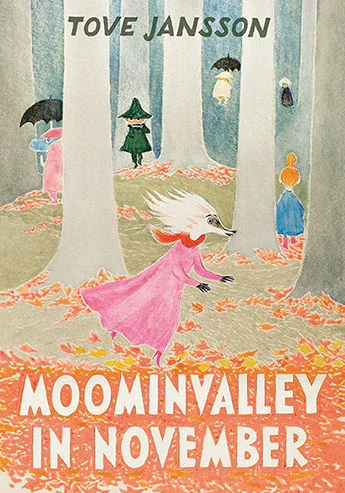
Moominvalley in November (1970)
The final book, Moominvalley in November, has no Moomins in it at all. The story follows directly from the previous novel, where the Moomins have left Moominvalley for their island lighthouse. The Moomins left without warning or notice, abandoning their house where so many of their friends used to gather and make memories. A new cast of characters, some new and some old, meet at the Moominhouse all in search of different things. This includes Mymble, Fillyjonk, Snufkin, Grandpa-Grumble, the Hemulen, and the new main character Toft.
Toft is a young orphan boy who visits Moominvalley after dreaming about the Moomins. He has never met them before, but he wishes for Moominmamma to be his own mother. When all the characters arrive, they move into the Moominhouse and attempt to cope with the absence of the Moomins and the mystery as to where they might be.
The book was written by Jansson during the same year her mother passed away. Using her writing as a way to cope with her loss, Moominvalley in November is a beautiful and melancholic tale about grief and how we rebuild from it. Toft is Tove Jansson’s self-insert character, depicting how she felt after the death of her mother. Even without this knowledge, the novel is able to convey these complicated emotions in a way that is sorrowful but still digestible for children.
Trove Jansson drew elements from her real-life to use in her writing, whether that is her experience during WWII, her queer identity, or her relationships with her mother and father. These adult themes packaged as universal adventures for all ages are what makes the Moomin books so unique and enduring, sure to entertain and comfort readers old and young for years to come.