
“Most enfranchised women in the world” - a history of the suffrage movement in SA
South Australia was founded by political idealists, traditionally supporting education for girls and holding tradition of property-owning women who paid council rates having the ability to vote in local council elections since 1861. On the 18th of December 1894, the Parliament of South Australia passed the Constitutional Amendment (Adult Suffrage) Act, solidifying South Australia as the one of the first places in the world to allow women the right to vote in elections, and the very first to allow women to stand in Parliament.
The campaign for women’s suffrage in South Australia was led by the Women’s Suffrage League, formed in 1888 with key figures including Catherine Helen Spence, Mary Lee, and Elizabeth Webb Nicolls. Suffragists from the league collected signatures from across the colony for the Constitutional Amendment (Adult Suffrage) bill, resulting in the most significant petition ever presented to the South Australian Parliament with nearly twelve thousand signatures.
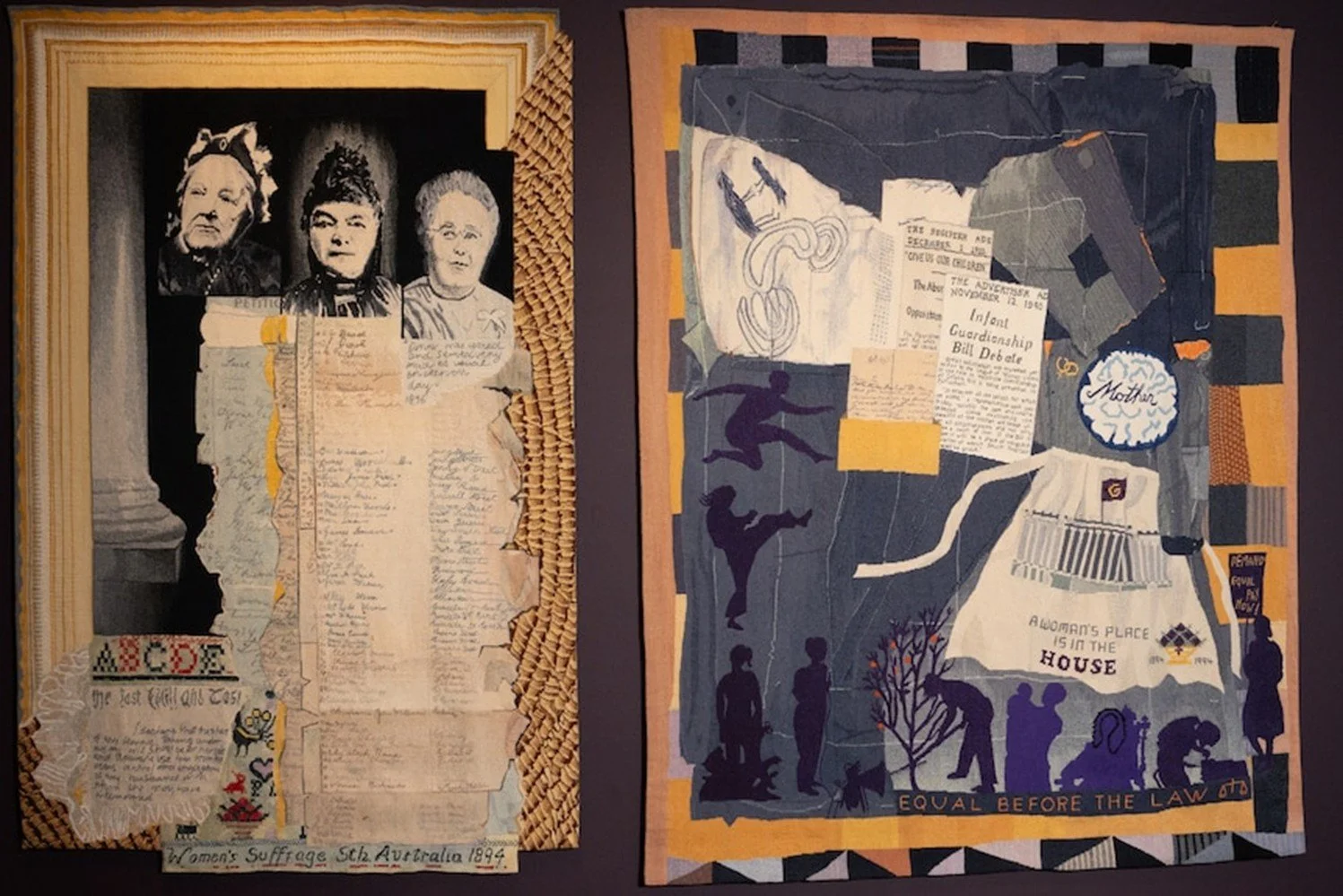
Tapestries Votes for Women and Equal Before the Law on South Australian suffrage by Kay Lawrence displayed in the South Australian House of Assembly. (Photograph: Justin Hewitson, ABC News)
The bill was presented as the seventh attempt from 1885 to 1894 to introduce voting rights for women within the Parliament of South Australia, and faced backlash from male politicians who argued the vote would “make women masculine” and that the role of women was instead to purely “assist her husband”.
Upon origination, the bill only included the right for women to vote, and did not fully expand equal political rights to men and women, including Clause 4 that barred women from being members of Parliament. Ebenezer Ward, a member of the South Australian Legislative Council was extremely outspoken about his opposition to women’s suffrage and attempted to destroy the bill by proposing an amendment to strike Clause 4. He did so on the assumption that his fellow male members of Parliament would find the idea of women in Parliament ridiculous, and that the suggestion would lead to the failure of the bill in the House of Assembly. However, the bill remained successful with a vote of 31-14 in favour, achieving three more votes than the majority required, and received royal assent in 1985.
The first female candidates for South Australian Parliament were Selina Siggins and Jeanne Young in the 1918 State Election, but a woman was not successfully elected to State Parliament until 1959 when Jessie Cooper was elected to the Legislative Council and Joyce Steele to the House of Assembly. The Act was eventually repealed and replaced by the Constitution Act 1934, but it remains that in December of 1894, South Australian women were the most politically enfranchised in the world.
Read further:
https://www.nma.gov.au/defining-moments/resources/womens-suffrage
https://theworld.org/stories/2019/12/17/remembering-australia-s-role-history-women-s-suffrage
https://www.parliament.sa.gov.au/en/About-Parliament/Women-in-Politics
https://www.abc.net.au/listen/programs/adelaide-breakfast/annabel-crabb/13442766
https://officeforwomen.sa.gov.au/womens-policy/130th-anniversary-of-womens-suffrage