
A Brief History of LGBTQ+ Rights in South Australia
The theme for the 2025 History Festival in South Australia is ‘decisions’. Decisions are defined by the people who make them, but are also important in the impact that they have on the larger community. One of the most significant ways that decisions are made are in state government and law-making, as these decisions made among a group of few affects many. This month I wanted to take a quick look at the laws that granted rights to LGBTQ+ South Australians and the timeline of significant cultural events that have changed the lives of many in the local queer community, starting with the first major victory for gay rights 50 years ago.
1975 – Homosexuality is decriminalised
As a former British colony, many laws established in the United Kingdom carried over to Australia. This included the criminalisation of homosexual activity specifically between males, as lesbianism was never acknowledged as a criminal offense.
The first significant attempt to reform this law came about in 1972 after the murder of Dr George Duncan: a gay lecturer who taught at the University of Adelaide. At a time when homosexuality was illegal in the country, the banks of the River Torrens were a popular meeting spot for queer men. George Duncan was one of three men who were targeted by a group of men that night and thrown into the river, and as he was unable to swim, he quickly drowned. It was believed then that the perpetrators were police officers, and this was all but proven in the coming decades until 1990 when there was deemed to be insufficient evidence to charge any person with Duncan’s murder. At the time, the murder sparked outrage and conversation about the laws surrounding homosexuality, and public opinion began to shift in favour of decriminalisation. A bill set to do exactly that introduced by MP Murray Hill was unsuccessful.

(Pictured) The site at the River Torrens where Dr George Duncan was murdered.
In 1975, two years after Adelaide’s very first pride march, MP Peter Duncan introduced another bill that set to decriminalise homosexuality, this time passing. South Australia is significant in wider Australia’s LGBTQ+ history as it was the first state to decriminalise homosexuality. Each state and territory legalised homosexuality at their own pace, and it wasn’t until 1997 that the entirety of Australia had followed suit with what was kicked off in South Australia.
1984 – The Equal Opportunity Act
South Australia’s Equal Opportunity Act was put into effect, prohibiting discrimination based on gender identity and sexual orientation. This was significant particularly in decreasing unfair treatment of queer people in the workplace.
2007 – The SA Domestic Partnerships Act
In 2007, laws came into effect that allow any two people to enter a domestic partnership. Under a domestic partnership agreement, same-sex couples could now have many of the same rights as married couples including joint finances, hospital visitation rights, and next of kin acknowledgement. This, however, still excluded same-sex couples and anyone else in a domestic partnership from parenting, with no access to IVF or adoption.
2017 – Same-sex marriage legalised nation-wide and progression of transgender rights
After a 61.6% majority vote from Australians to support same-sex marriage, the Marriage Amendment Act came into effect at the end of 2017. However, that same year there was another legal change in South Australia specifically affecting transgender citizens. Previously, if transgender people wanted to legally change their gender on their birth certificate, they would be required to have sex reassignment surgery and divorce if they were married. For reference, the first trans woman legally recognised in Australia was model Estelle Asmodelle in 1987. 30 years later, a bill removing these requirements was passed in 2016 and put into effect the following year, allowing anyone over 18 to change their gender with only a psychological assessment. While ACT implemented this beforehand, South Australia was the first of the states to implement this change in law.
2021 – Gay panic defence abolished
While South Australia has historically been ahead in terms of the progression of LGBTQ+ rights, there are some aspects in which we have fallen behind. The gay panic defence, a legal strategy allowing perpetrators of violent crimes against queer people to claim self-defence after unwanted sexual advances, was still active in South Australia until 2021, four years after the rest of the country had removed it. Despite the legislation passing in 2020 and law now prohibiting this going into effect the following year, the gay panic defence is still reported to be used in court in South Australia.
2025 – Conversion therapy banned
Conversion therapy is an illegitimate form of therapy that attempts to change queer people’s sexual or gender identity to align with traditional heterosexual and cisgender norms. Passing last year in 2024, legislation that bans practice of conversion therapy in South Australia only went into effect in April. This is a powerful reminder that history is still being made and the struggle for equal rights is ongoing. Even though we have come a long way in the past half-century, we are still living in a time of change. So…
What next?
South Australia’s battle for LGBTQ+ rights is far from over.
In 2021, it was discovered that a loophole in the Equal Opportunity Act 1984 still allows discrimination of gay workers in religious organisations including schools, leading to gay teachers and students being expelled on grounds of sexuality alone. This is becoming all too common across the country.
As of today, invasive medical procedures are being performed on intersex children without their consent. ACT passed laws that put an end to non-consensual surgeries on intersex minors in 2023, but the rest of Australia is yet to follow suit.
Despite initially being 12 months, men who have sex with men are required to abstain from sexual activity for 3 months before being able to donate blood or plasma.
These are just some of the many discriminations that LGBTQ+ South Australians are still experiencing in 2025, and it is important now more than ever to engage in Adelaide’s queer community and fight for our individual rights. While people in power ultimately make decisions to change law, you can still make the decision to be an ally and create power in numbers and engaging in activism and protesting these outdated laws.
Want to learn more about South Australia’s LGBTQ+ history?
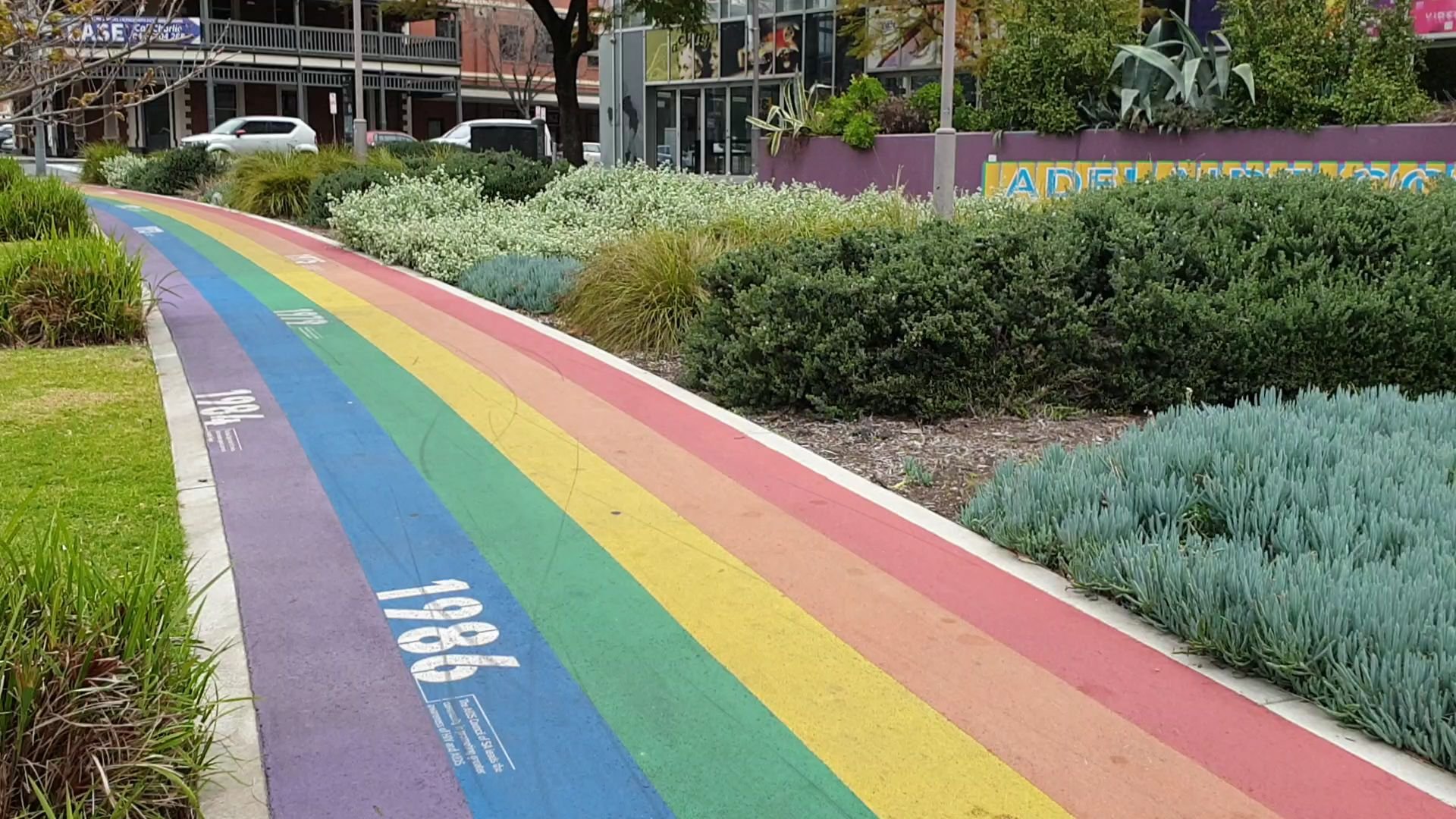
The Pride Walk is a rainbow-coloured walkway in Light Square that details a timeline of many significant events relating to LGBTQ+ rights in South Australia. If you want a more expanded timeline of queer milestones, wins, and tribulations, I highly recommend walking along it yourself and taking some time out of your day to read through our history.