
Why South Australia’s political history still matters today?
Politics is often thought of as elections, boring old politicians arguing on TV, or more recently social media activism. Unless you are already interested in Politics, you might not know about South Australia’s interesting and sometimes rebellious political history. From women's rights to First Nations rights, South Australia's political story has been shaped by bold decisions, controversial leaders, and movements that changed not just the state, but history of Australia.
So, why should we care about a history of politics that stretches back to past the1800s? At the core, understanding our political and social roots helps us understand the truths of the past, the power of people to influence change, and the importance of continuing to strive to make history.
Colonisation and the Birth of South Australian Democracy
When it was first established in 1836, South Australia wasn’t a democracy as we know it today. In fact, most of the power in the hands of the British monarchy, through the appointed Governor. Very few people were in a position of real power, this was reserved for only a select group of wealthy, property-owning white men. This was until the 1850’s when South Australians started demanding more equitable governance that represented them. Shortly after, followed the formation of the Constitution Act of 1856, which transformed South Australia into a self-governing colony with the same bicameral parliament that we see today.
This includes a legislative body composed of two separate chambers or houses, often referred to as the Legislative Council (Upper house) and House of Assembly (Lower house). The two houses have distinct functions and play a significant role in the functioning of South Australia today. The style of government we have shapes the way our modern elections and democratic processes run, such as compulsory and preferential voting.
South Australia's Revolutionary Firsts

Quickly after colonisation South Australia became a global trailblazer.
In 1894, South Australia became the first place in the world to allow women to vote. This was also accompanied with the right for women to stand for parliament at the same time. Disappointingly, South Australia missed the chance to be the first place is the world for a woman to vote because of when South Australian elections fell. New Zealand gave women the right to vote in 1893, which was enacted prior to their 1893 federal election giving making New Zealand the first country to have a ballot cast by a woman.
Working conditions in the British Empire’s colonies included little regulations on workplace conditions, long working days and with little pay, South Australia passed world first legislation to combat this. The legislation specially regulated wages, working conditions and maximum hours to create a safer and more equal workplace.
In 1966, SA led the way in passing the first piece of Australian legislation banning racial discrimination. It prohibited discrimination based on race, country of origin, or the colour of someone’s skin. Racial Discrimination such as service refusal, discrimination in employment and access to land ownership are all practises we still see regulated by this legislation.
This would be a pivotal move in the lead up to the 1967 national referendum that granted the Commonwealth government legislative power for First Nations people.
In 1975, homosexual activities between consenting adults were decriminalised in South Australia, the first in Australia. This landmark decision was spearheaded by then Premier Don Dunstan, who also legislated an equal age of consent for all sexual acts. This also led to a scheme that allowed for the removal of convictions for consensual gay sex from records prior to 1975. These were all very radical for the times they were proposed, even though now we take these as commonplace parts of society.
The 'Dunstan Decade'

The striking visibility of his pink shorts wasn’t the only bold choice Premier Don Dunstan made during his time in office.
Alongside decriminalisation of homosexuality, he also pioneered radical social reform in South Australia. His progressive policies around sex discrimination, land rights for First Nations people, consumer protection laws, child protection reforms, urban planning, heritage protection, abolition of capital punishment, environment protection and censorship were radical for Australian politics. He was also one of the leading politicians for immigration reform and the elimination of the White Australia Policy.
He proved that politicians could be both visionary and relatable. In the current political climate of division and uncertainty, the little bit of hopeful and creative progression like Dunstan’s approach could allow for long-lasting systemic change in the modern age.
Power, Scandal, and Crisis
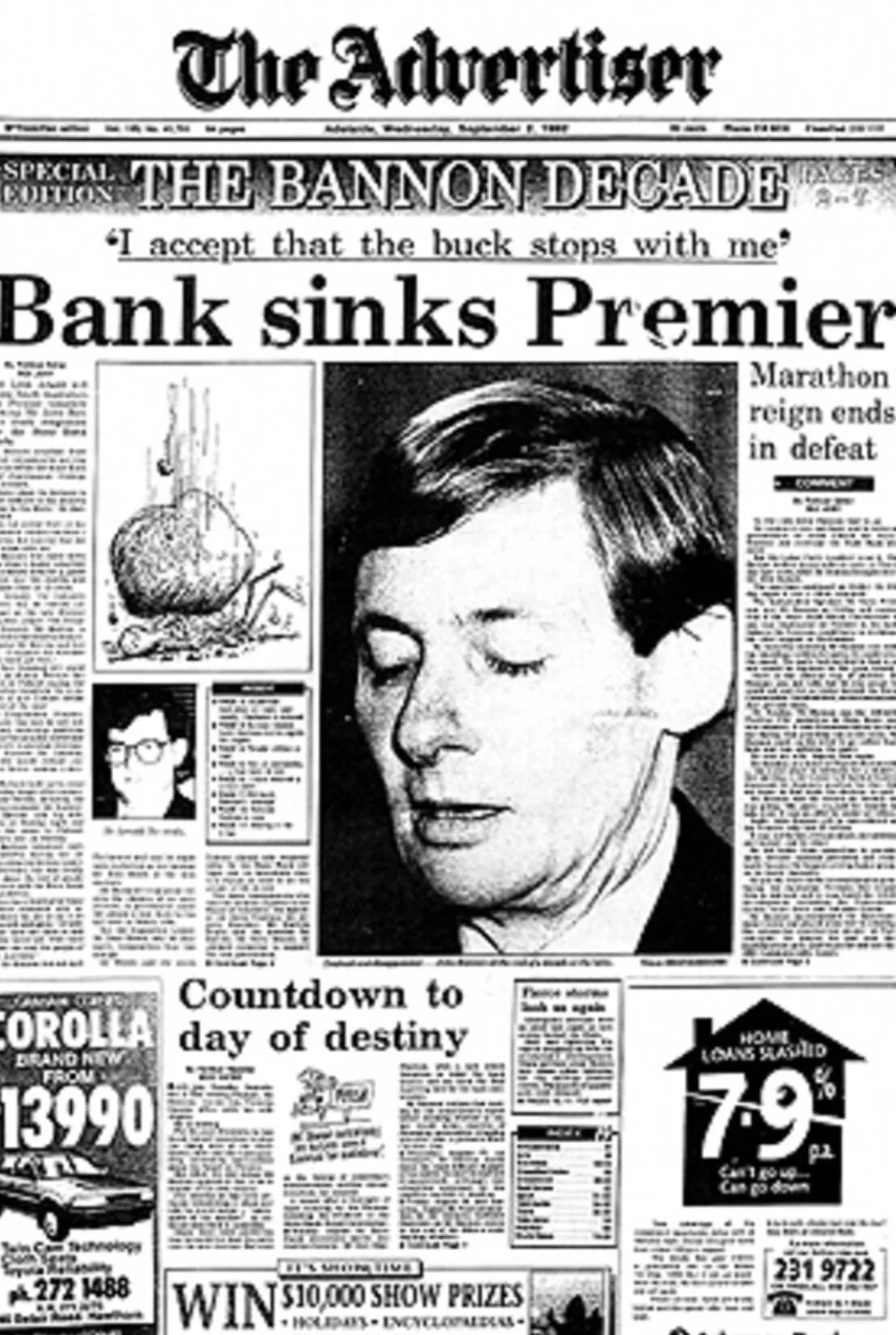
While South Australia has a history of revolutionary acts and radical figures, it isn’t exempt from traditional messy, scandalous politics. The 1990s in South Australia were tainted by the disaster of the State Bank collapse. It remains the largest financial crisis the state has seen, and left the state in multimillion dollars’ worth of debt, destroying confidence in politicians and locals for years.
The State Bank was created in 1984 from the merging of government-owned State Bank and the Savings Bank of South Australia. The government-owned State Bank was the first of its kind in Australia, with Vicotria and NSW following soon after. Savings Bank of South Australia was opened shortly after colonisation in 1848. It consisted of one employee and was aiming to serve working class men and educational savings. In the years from 1896–1920, the bank funded £7,250,000 of loans to around 10,000 mortgagors, making it one of the most successful in the country.
After the merger, the appointed managing director Tim Marcus Clarke utilised this to embark on a major expansion of South Australia valued over $500 million. Ultimately, a Royal Commission was conducted into the bank collapse. The results of the Royal Commission cleared both the Labor premier John Bannon and the bank’s managing director Tim Marcus Clark of any specific wrongdoing. This being said, Bannon resigned as premier and the Labor government was defeated the next election, finding difficulties in regaining the trust of the public for years after.
The collapse was a pivotal piece in the subsequent Liberal government’s push for privatisation of the Electricity Trust of South Australia. The trust in the Labor party was at an all-time low in South Australian history, conflated with the Federal leadership spill of the Australian Labor Party (ALP), where Backbencher and former treasurer Paul Keating defeated Prime Minister Bob Hawke, who had led Labor for eight and a half years. While the cause of the collapse is contested, the Royal Commission deemed that a combination of policy and procedural inadequacies as well as a significant lack of effective control and supervision of the bank contributed to the collapse.
Labor government has since been able to regain a strong majority in South Australia, with the Liberals holding power for just 14 of the last 50 years. Politics is a strange balancing act between ensuring the benefits of the economy and the citizens of the state. South Australia had to balance this during the Pandemic, where economic growth was second to the health and welfare of citizens.
To the future and beyond
South Australia’s history has been marked by reflection on systemic issues and bold policy decisions that revolutionised the lives of everyday people. While Don Dunstan was certainly an atypical politician, he paved radical and wide sweeping all with his typical flair and charisma. This can be seen reflected in a new wave of ‘Personality Politics’, full of charismatic and colourful characters throughout parliaments and on election campaigns across the world.
While not all politics is perfect; learning, adapting, and accountability ensure we are always informed in our future. Even though the political climate has changed significantly from when South Australia first affirmed democratic processes, we still need to consider what bold political decisions will this generation make. On the back of the 2025 Federal Election, we saw housing affordability, cost of living and climate action providing no shortage of issues facing Australians.
So, what’s the point of digging through all this history? Can’t we just leave the past in the past? South Australia’s political story isn’t only about inspiring people to make change, it’s a way of understanding the society we live in today and looking to how we can move forward collectively. The ability to apply critical thinking and empathy to the circumstances of the past allows us to consider what and how we should remember our history. The Dunstan era of South Australian politics lead the way for progressive policies that are still in practise today. Reflecting on their impact and how they can be applied to contested issues of today such as gender affirming care, climate change and First nations justice.