
The Many Themes and Inspirations of the Moomins - Part One: War
illus. Tove Jansson
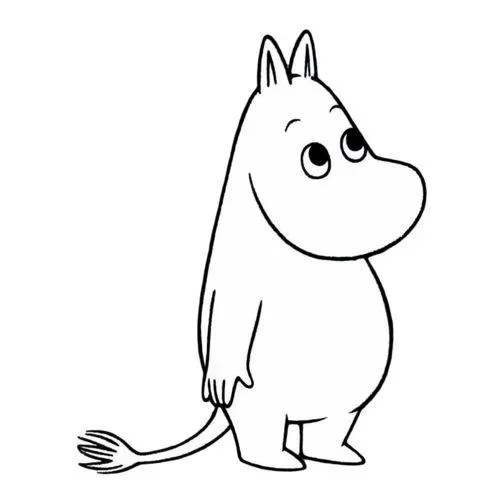
Whether you know his name or not, you’ve likely seen this pudgy white troll at some point in your life. Moomintroll is just one of the many residents of Moominvalley, a fictional neighbourhood created by Finnish author Tove Jansson. While there have been numerous comic strips, picture books, TV shows, and even movies based on the Moomins, the core of the series lies within the original nine novels, the first of which was published 80 years ago this year.
The Moomins have been around for a while, and the novels, written over a 25-year period, reflect attitudes of the time, mostly the attitude of Jansson herself. She used the Moomins as a way to express her own feelings about war, her queer identity, and her relationships with her parents.
This article is the first of three that will take a brief look at these key themes that inform the Moomin novels and how Jansson expresses real-world issues in this quaint fantasy world.

The Moomins and the Great Flood (1945)
The very first Moomin book, The Moomins and the Great Flood, was written by Tove Jansson during World War II. It was a commercial failure upon release and did not receive an English translation until 2005. Its unpopularity has caused it to be viewed by many Moomin fans as a precursor to the other “official” Moomin books – the foundation for all that came afterwards. However, it remains a crucial part of Moomin history and introduces several key elements of the canon.
The story follows Moomintroll and Moominmamma as they search for Moominpappa, who has been separated from his family after a disastrous flood. We journey with the two Moomins as well as a small creature (later identified as Sniff) as they find their way to a new home, eventually discovering Moominvalley: the setting of all following stories. The story is clearly inspired by the devastation of war and people’s lived experience when faced with the realities of World War II.
The book reflects themes of disaster, loss, and sorrow, but Jansson also contrasts this with glimpses of hope and an opportunity to rebuild after tragedy. The Great Flood ends on this happy note of reuniting with family and finding a new home as a way for the readers (and Jansson herself) to escape the darkness of the war. Jansson uses Moominvalley as escapism often throughout the series, as a place where everyone and anyone can feel at home even when the outside world is frightening .
Comet in Moominland (1946)
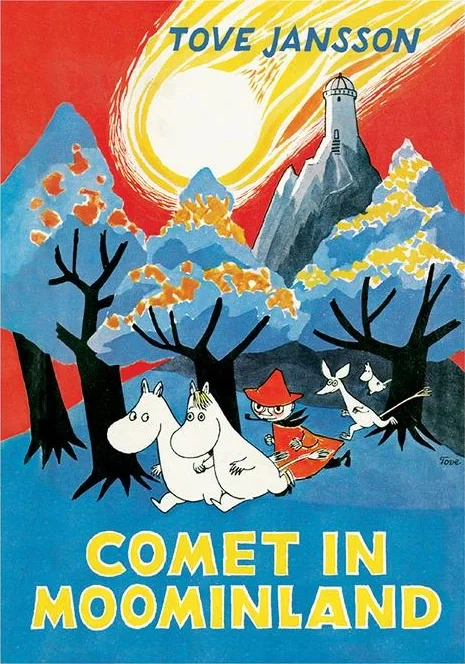
These themes of fear during wartime continue in the sequel novel, Comet in Moominland, released just one year later. This is perhaps the most famous Moomin story, with two Moomin films adapting this particular tale (I personally recommend Moomins and the Comet Chase (2010), which features gorgeous felt stop-motion animation, a voice cast that includes Stellan Skarsgård and Mads Mikkelsen, and an original song sung by Björk).
Now settled in Moominvalley, the Moomins and Sniff are faced with a new looming threat: a comet headed straight for Moominvalley. This book expands the cast of colourful characters to include the wandering free-spirit Snufkin, the brainy Snork, his bubbly sister Snorkmaiden, and the cynical philosopher Muskrat. The Muskrat is the first to warn the Moomin family of the impending doom of the comet, leading Moomintroll and Sniff to undergo a quest to a faraway observatory, meeting new friends along the way.
Existential dread is not a typical theme for books aimed at children, but the time in which Comet in Moominland was written was anything but normal. Cities around the world were ravaged by war and frequently bombed, including Tove Jansson’s home city, Helsinki. The book features a lot of imagery that parallels experiences of citizens during air raids, such as hiding in bomb shelters and fleeing with all necessary possessions in tow. On a larger scale, the comet in Tove Jansson’s book can also be read as a representation of the atomic bombs that devastated Hiroshima and Nagasaki, and in turn the fears of atomic warfare that bled into the Cold War. Despite these fears, Jansson focuses on small moments of joy - kicking rocks or dancing with friends - and the comfort of family.
These two novels are an enduring example of the perseverance of art during wartime.
Next week: the quiet queerness in Moominvalley.