
Radical Youth: Student Protests That Changed Australia
Young people are continuously carving out their own paths and demanding a better future. Whether it’s marching through the street or creating online petitions, you can’t deny that throughout history, young people have been at the forefront of social and political change. Today, Gen Z continues to carry the torch of activism and while the causes may shift, the spirit of youth resistance remains.
This article explores some of the many powerful examples of youth activism that have taken place right here in Australia!
Freedom Riders – 1965
February 1965, a group of students from the University of Sydney peacefully protested against discrimination of Aboriginal people by embarking on a fifteen-day bus journey from the western and Coastal New South Wales; touring through Walgett, Gulargambone, Kempsey, Bowraville and Moree (Deadly Story 2025).
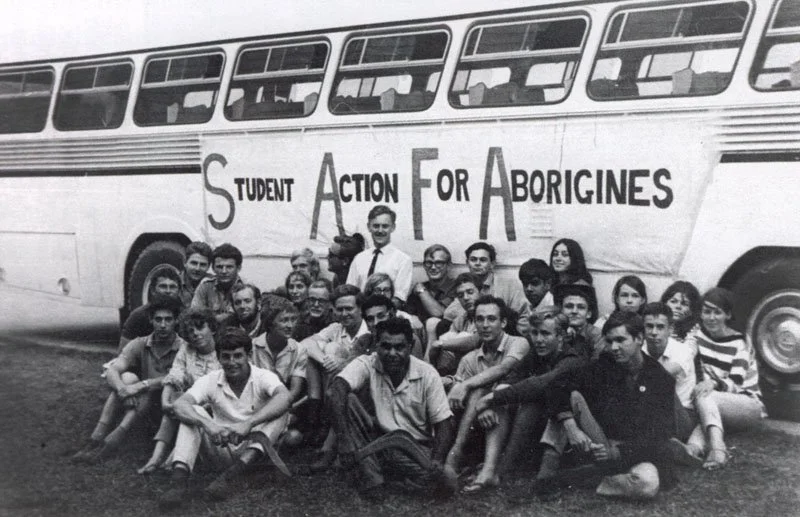
25 February 1965, New South Wales
Thirty participants in front of the SAFA bus on the Australian Freedom Ride
(Wendy Watson-Ekatein and Ann Curthoys)
One of the most paramount moments occurred in Moree, in northern New South Wales. There, the Freedom Riders decided to take a few Aboriginal children to the local pool but were denied entry due to a council by-law. In response, the group held a three-hour protest which was received with hostility and an unwelcoming local crowd.
One student wrote in her diary:
“It was very hot and crowded and noisy that day. Police escorted the party, and they walked single file through the crowd who threw eggs, tomatoes, stones, and spat at us.”
This confrontation at the Moree pool became a power symbol of the systemic racism Aboriginal people endured.

SAFA (Student Action For Aborigines) Protest
Outside Moree town hall and council chambers
(Mitchell Library, State Library of New South Wales)
Simultaneously, the peaceful protest sparked a continuous cycle of resistance and resilience against the injustices faced by Aboriginal people. The Freedom Riders amplified the voices of Aboriginal communities and inspired broader movements for equality and justice across Australia.
Anti-Nuclear Protests – 1980’s
After the Hiroshima and Nagasaki atomic attacks in 1945, many countries began developing nuclear technology – however, along with exciting new emerging technologies, a new host of dangerous challenges arose.
Australia joined the International Atomic Energy Agency and began to promote nuclear research within the country. However, in 1964 several major Australian cities held Ban the Bomb marches and protests condemning the nuclear testing programs.
These marches continued on for years, and these early demonstrations laid the groundwork for more robust activism (Antje 2021).
A pivotal moment came during the 1980’s with 100,000 participants in 1982 – and 350,000 participants by 1985. The marches were often led by young Australians who organised mass campaigns, engaged in public resistance and overall, served a very important factor in Australian politics (Labourhistory, 2025).

Rally in Melbourne, 1978
Marchers at a Melbourne Movement Against Uranium Mining
(Commons Library)
As shown in the image above, there were always massive turnouts to the inspirational movements. The youth turnout is also quite notable – the presence of young people and students highlights the important role that youth played in political decisions.
Student Fee protests – 1990’s – 2000’s
Student university debt levels have rapidly increased since the HECS fees were introduced more than thirty-five years ago, sparking decades of student-led protests across Australia. Throughout the 1900’s and early 2000’s, university students organised nation-wide rallies to oppose rising student fees (Solidarity, 2023).

University of Sydney students, 1994
General student fee protests
(The University of Sydney News)
One of the earliest and most notable mass actions was in 1966, when the Howard government proposed a 25% increase in HECS fees, cuts to university funding and the introduction of full fee-paying domestic student places. Young Australians did not take this lightly and organised nationwide protests, including student walkouts and university occupations.
For instance, in 2020, students protested the Job-Ready Graduates package which increased fees for humanities and arts degrees while cutting support for other courses. Students held rallies under pandemic restrictions and protested opposing the decision.
Student Strikes for Climate – 2018
Many are familiar with the name Greta Thunberg - the Swedish teenager who sparked a global movement by striking from school to demand climate action. Her courageous and bold decision inspired students all around the world, including here in Australia.
On November 17th, 2018, over 1,000 individuals joined a Facebook group titled School Strike for Climate, created by the Australian Youth Climate Coalition. The community served as a platform for students aged five to eighteen to coordinate and discuss plans for climate action (Mik Aidt 2018).
Then on November 30th, 2018, thousands of students from every state capital and at least twenty regional towns across Australia walked out of their classrooms to demand stronger action to climate change.
The movement faced criticism from political leaders including then-Prime Minister Scott Morrison (News 2018).

Young Queenslanders gathered at Parliament House in Brisbane.
(ABC News: Lucy Murray)
During this period, Australia witnessed the emergence of youth-led climate strikes which laid the foundation for larger mobilisations in 2019.
One significant strike organised by high school students across the country is called School Strike 4 Climate, which is now recognised as one of the largest youth-led protest movements in Australian history (Slezak & Davis 2023).
These strikes not only challenged political inaction on climate change but also empowered a new generation of activists to take leadership on environmental issues.
Black Lives Matter Protests – 2020
The phrase Black Lives Matter dates back to 2013 after the shooting of Travyon Martin and gradually grew in usage in the United States regarding deaths of African Americans.
In 2020 the movement reached new heights. After the George Floyd incident in the United States, significant concerns were raised about the extent and pervasiveness of racism within the criminal justice system, not only in America but in Australia as well.
Protesters gathered in major cities across Australia demanding justice over minority deaths in police custody in solidarity with the Black Lives Matter movement.
“To know that I stand on the shoulders of black, queer people before me who have enabled me to live the life I lead, I had to ask myself if I was going to be the ancestor that people after me needed me to be” – Jeremy, CNN
In addition, Australian BLM supporters recognised the parallels between the American movements and Australian context of discrimination against Aboriginal Australians, which sparked a desire to also protest for specifically racial profiling, police brutality and Aboriginal deaths in custody.

Photograph of the BLM rallies in Perth in 2020
One specific rally in Perth gained a lot of media attraction because of the 10,000 people who attended the rally at Langley Park on Saturday June 13th, 2020.
Despite pleas from the Premier to delay the event amidst COVID-19 situation, the rally was organised and led by youth advocacy group Boorloo Justice.
To sum up,
From fighting for Aboriginal rights in the 1960s, to demanding urgent climate action in recent years, young Australians have repeatedly shown that they are willing to stand up, speak out, and drive meaningful change. These moments are just a few of the many powerful and inspirational examples of youth activism that have taken place in Australia.