
South Australia’s Ball of Fire: a history of the ‘Karoondarite’
What do we call history? Mostly it’s big world events. Sometimes it’s personal. And sometimes it sits at the intersection.
That intersection is where I would place this contribution to the South Australian History Festival, a story that was once heard around the world, but is now unknown to just about anyone outside of a 500 person farming town where my dad grew up, two hours away from Adelaide.

Camping Under The Milky Way - Karoonda | Ashley Hoff (@kustoms.on.silver)
“Fireball”¹, “Flaming object”², “Heavenly body”³. Such were the headlines in South Australian newspapers following the 25th of November, 1930. That night, at 10:53pm, a meteorite flew through the country sky and crash-landed somewhere to the east of a town called Karoonda. Evidently, whoever named it had little creativity, as the meteorite would later be labelled the ‘Karoonda Meteorite’.
Despite the boring name, the ‘Karoonda Meteorite’ was anything but. Visible for only six seconds as it flew through the sky, it could be seen from up to 400 kilometers away, reaching into the edges of Victoria and New South Wales. For those closer to the source, the light-show was like nothing you’ve ever seen before.
“Some who saw the heavenly body in its flight to earth said it was brilliant red, then pale blue, fading to sickly yellow” reported The Advertiser the next day². “Others claimed that throughout its flight the visitor retained its fiery color.”
Mr. F. J. Honeyman, who worked on the railway that passes through Karoonda, provided the closest account of events near the crash site and was an invaluable source in beginning to locate the meteorite. Describing its fall he said:
“Suddenly the whole place was flooded with a bright light, coming rapidly from the sky. It grew as bright as day. The glare became intense, just like a thousand high-powered acetylene lamps wrapped in one… Then a loud explosion took place… The house we were standing near shook, and the telephone wire vibrated with a peculiar singing sound.”⁴
Continuing to describe the immediate aftermath, he said to reporters that “the explosion was followed by a cracking sound, which spread from the place where the explosion took place right back into the sky and ran back along the trail the ball of fire had travelled. Rumblings appeared in the sky, and then all was quiet again. We knew a meteorite had fallen, or that some mighty disturbance of nature had taken place.”
In the following days, a search party was assembled and began looking for any sign of the fallen debris, led by Government astronomer Mr. G. F. Dodwell and Professor Kerr Grant of the University of Adelaide. On December 9th, just two weeks after it crash-landed, the meteorite was found only 2 ¼ miles (3.6km) east from the town in a crater 18 inches (45cm) in diameter and depth. The meteorite had been a single rock that broke apart on impact, with the biggest piece being 7lb (3.2kg), and all pieces weighing a total of 92lb (41.7kg).⁵
Following the discovery, most of the meteorite was handed over to the Museum of South Australia, with some pieces being used for research, and another being kept by the District Council for Karoonda East Murray to display. It stayed there until October 2022, when the final piece was given to the museum.
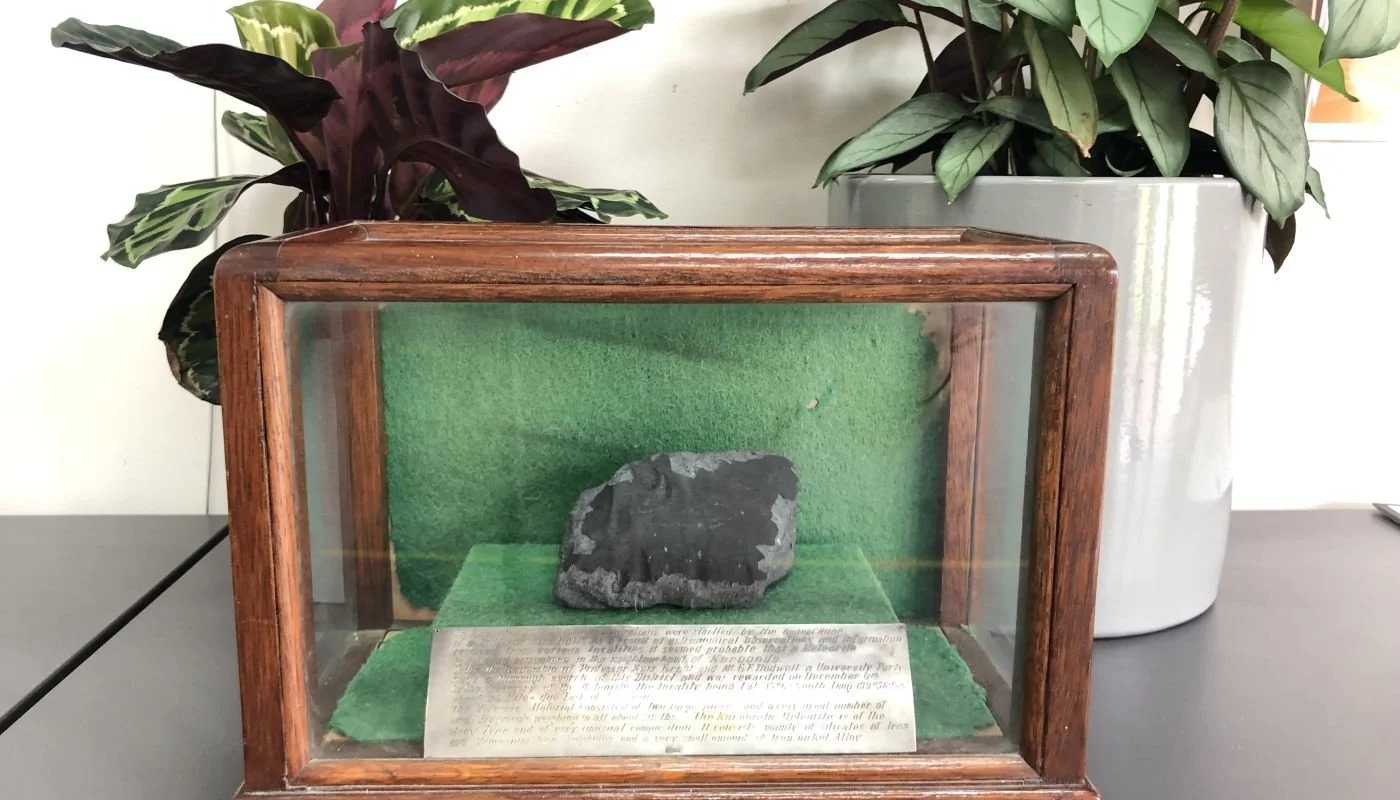
The final piece of the meteorite on display | District Council of Karoonda East Murray
Though the physical impact was localised, the metaphorical impact was felt throughout the astronomy sphere. As it turns out, the humble ‘Karoonda Meteorite’ was quite a rare find.
First of all, it’s already a relatively unique phenomenon for a meteorite to be seen falling and be found in such a short time span. According to astronomy lecturer Paul Curnow of the Adelaide Planetarium, “most meteorites when they're found maybe have been sitting in the environment for thousands of years, millions of years.”⁶
Then, on a more scientific level, the mineral composition of the meteorite takes it to a whole other level of rarity, with a mixture of nickel, iron, and magnesium. Mr Curnow stated that “This particular meteorite is a stony type meteorite and they're fairly rare, and what makes it even more rare is it's a carbonaceous chondrite, so it contains carbon… they only represent about 4.6 percent of all falls.”
Information about the ‘Karoonda Meteorite’ is still being used in astronomical and geological research papers to this day, and parts of it can be found in research facilities and museums all over the world. You can find it anywhere from the University of Adelaide and Museums Victoria, to the University of Arizona and the American Museum of Natural History. And if you want some for your own personal collection, the going rate on eBay is $100 for one gram of rock.
Today, the town marks this momentous occasion with a monument in the middle of town. An obelisk was erected on the 27th of May, 1932, with an attached plaque commemorating the ‘Karoonda Meteorite’:
“This column is erected to commemorate the fall and finding of the Karoonda Meteorite which fell as a brilliant fireball at 10-53 p.m. on Nov. 25 1930 and was found by Prof. Kerr Grant & G.F. Dodwell Esq. 1¼ miles east of this point.”

The meteorite monument stands in the middle of town | Jodie Hoff
This article was written as part of the South Australian History Festival. Check in with Hub over the month of May to see more South Australian stories!
¹ LOCATING FIREBALL (The News, Dec 3rd 1930) https://trove.nla.gov.au/newspaper/article/128959221
² BALL OF FIRE (The Advertiser, Nov 26th 1930) https://trove.nla.gov.au/newspaper/article/29849905
³ THE KAROONDA METEORITE. (The Bunyip, 26 Dec 1930) https://trove.nla.gov.au/newspaper/article/96669281
⁴ THE KAROONDA METEORITE. (Burra Record, 24 Dec 1930) https://trove.nla.gov.au/newspaper/article/37489976
⁵ The Karoonda (S.A.) Meteorite of Nov. 25, 1930. (Nature, vol.127 pg. 402-403, 14 March 1931) https://www.nature.com/articles/127402b0
⁶ Meteorite that put Karoonda on the map 92 years ago heads to South Australian Museum. (ABC, 18 Oct 2022) https://www.abc.net.au/news/2022-10-18/karoonda-meteorite-finds-new-home-at-sa-museum/101544712