
Board Games From South Australian History
As an avid board game collector, I found that Australian history month got me thinking about the history of board games and what historical games have relevance in South Australia. Luckily, the State Library of South Australia actually has a collection of board games; some from over 100 years ago, along with downloadable versions to allow board gamers to play these games while discovering some fun history. Here are just a couple of these games, including the background given by the State Library, how to play them, and how fun they are from a modern-day perspective!
Around The Commonwealth:

Background History:
Australia has a rich pre-colonial history, dating back thousands of years and living on through Australia’s First Nations people and beautiful natural landscapes. In 1788, the ‘First Fleet’ from Britain arrived. Over time Australia became divided into six very separate colonies that reported to Britain. In 1901 these colonies were united to form the Commonwealth of Australia and became a federation. At this time in history, aeroplanes were new and had to make many stops to refuel. ‘Around the Commonwealth by Aeroplane’ was created in the early 1900’s by the ‘National Game Company’ of Ballarat and Melbourne, making them the first big company to make board games in Australia.
Gameplay:
‘Around the Commonwealth by Aeroplane’ is a very easy game with, unfortunately, no skill. Each player simply rolls the die and moves the number of circles shown. If a capital city is landed on, the player gains another turn. If a player lands on a large town, they lose a turn (I imagine the players are spending time seeing the sights!) The first player to return to the start wins.
As you can see, this is a game of complete chance, although flying around an old map of Australia, including a massively expanded South Australia (sorry Northen Territory) has some novelty. It does, however, have similarities with the popular modern game, ‘Ludo’, in which players must roll around the board without interacting with anyone else.
Race to the Gold Diggings of Australia:

Background History:
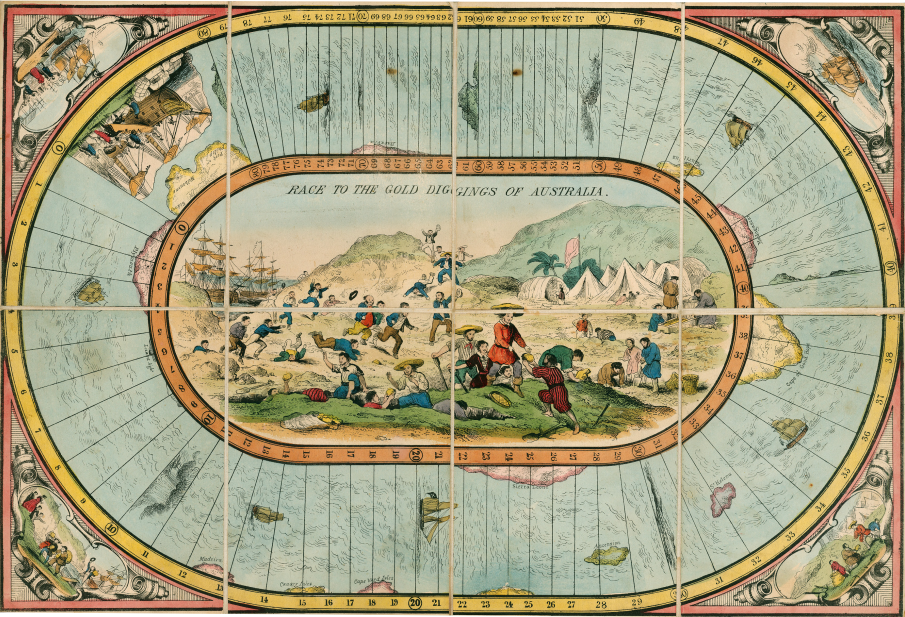
The Australian gold rush began in Victoria in 1851, with many people travelling from all over Australia and other parts of the world trying to make their fortune. ‘Race to the Gold Diggings of Australia’ was created in England some time between 1850-1869 and tells the story of the race by sea from Britain to the Australian gold fields. It was printed on linen cloth and hand painted, so it isn’t quite a ‘board’ game. You can see pictures of travel and the goldfields around the blue circular sea.
Gameplay:
The object of the game is to sail the hazardous ocean voyage from England to Victoria. Players roll the dice and move the corresponding number of spaces, with various pitfalls, movement opportunities, and traps along the way.
In a developing theme, this game is, again, completely reliant on luck. This is a shame because the concept of a board game centred around the movement of people to Australia during the gold rush is extremely appealing in a thematic sense.
The National Football Game:

Background History:
Aboriginal groups in north-west Victoria had been playing a football game called marngrook, which revolved around the ‘marking’ of the ball after being kicked high in the air, similar to the marking which we see in modern Australian football. The official start for Australia Rules football in South Australia was 1877. The ‘National Game of Football’ was created in the early 1900s by the ‘National Game Company’ of Ballarat and Melbourne. They were the first big company to make board games in Australia. The game is designed to resemble a game of football as the ball is moved towards and away from the goals.
Gameplay:
The game features four unique quadrants in which the ball is kicked back and forth. Each player selects a colour, beginning with red. The first player rolls the dice and moves the ball in the red column. The next player rolls the dice and moves the ball back along the red column. The roll can take you past the space marked ball and down your own column.
If a player lands on the space marked 5 or 8, they get an extra roll. Additionally, if the player rolls a 6, they also get an extra roll. The first player to land on the goal space with an exact roll, wins the game.
While yes another completely luck-based game, I do find this title to be thematically the most appealing. Football is such an iconic part of Australian culture, and so for those with not a lot of interest in difficult board games but a love for sport, this just may be the game for them!
Conclusion:
Despite what many may think, history can be fun to learn. When considering ‘what is worth remembering’ it is vital to remind ourselves that between historical figures, wars, and events, that art is worth remembering. After all, what is the point to life, if not to experience the art, cultures, games and landscapes around us?
To download these games, or check out the full collection, head to the State Library of South Australia’s website linked below!